Monday, May 16, 2011

water writes mural complete

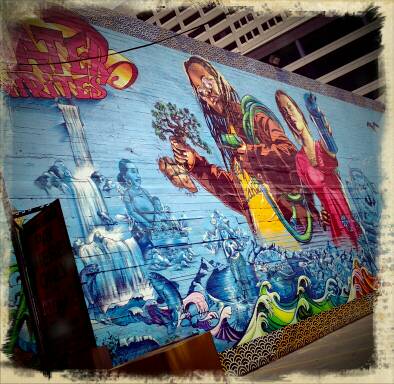
The 6,000 sq ft monumental mural and Oakland chapter of the water writes project is complete.

I'm proud to have been a part of the creation of something so great!
Shout outs to all the homies who worked on this.


Water Writes will travel to ten cities around the planet over the next year creating original murals that will express the perspectives of communities highly affected by water issues. The campaign aims to educate and empower communities to express their voice visually through public art.

The Estria Foundation takes a community building approach to the creation of the Water Writes mural series. In Oakland, the Foundation partnered with local organizations that work with community youth to host a series of workshops on their relationship to water. While the water crisis is global, each community struggles with their own issues and has their own perspective, and the workshops are a vehicle for these impacted communities to constructively and artistically tell, or write their stories. Working side by side, artists and youth came up with a storyboard depicting their local to global visions of water. The public paint party will mobilize over 100 community members to bring the mural to life, each person painting a part of their own story with their own hands.

Confirmed Sites:

  1. Los Angeles, CA - Completed
  2. Oakland, CA - Completed
  3. Honolulu, HI - June 2011
  4. Gaza Strip, Palestine - July 2011
  5. Palawan, Philippines, July 2011
  6. El Salvador, August, 2011
  7. Window Rock Arizona- September 2011
  8. Bogota, Colombia - October 2011
  9. Klamath River, Northern CA - November 2011
  10. Suprise……………..

With LA done, that's 2 down eight to go.

For more info go to:
estria.org

Article in Colorlines


Official Video For ESTRIA FOUNDATION by Shadi Rahimi here:


If you're around come to the unveiling:

Thursday, May 19 @ 4:00pm - 7:00pm

Parking Lot @ 21st & Broadway. Oakland, Ca


DJ Agana. DJ Baby Tiger. DJ Mixtek.
BRWN BFLO.
HOPIE.
Arts and Crafts with Recycled Materials.
Photo Booth with finished Mural.
Performers and lots of Love.

Free Event! All Ages!

If you post on Twitter, please use #WaterWrites

Feel free to add your photos to our Flickr #WaterWrites group:
http://www.flickr.com/groups/1621370@N20/


Published with Blogger-droid v1.6.9

Monday, January 24, 2011

"The Savage"

Josué Rojas 2010

Oil and ink on canvas

36"x60"


Description:

“The Savage” is an image that stands at the brink between modern gang culture and ancient Mayan imagery; a snapshot that includes elements of satire, comic book art, and portraiture. The ambiguity of the face (whether it belongs to an ancient warrior or a Los Angeles gang member) is the object of this piece.

The Savage presents ancient Mesoamerica culture and popular culture together simultaneously.

Friday, January 14, 2011


These abstracts are the latest in series.

They represent thinking that happen simultaneous with other works. The abstracts are a

“break” from the critical/satirical work that are comics and caricatures, and are in extreme contrast the hyper literal

work of documentary video which characterizes much of my work.


These “Visual Improvisations” are lyrical and playful.

They are updated versions of previous work and express a pure unadulterated love for the medium of painting.


(Above)

"Untitled Abstract #5"

2011

Acrylic, Oil and Resin on Canvas

8” x 10”


Click to zoom


(Left)


"Untitled Abstract #3"

2011

Acrylic, Oil and Resin on Wood

8” x 10”


Click to zoom


(detail)


"Behold Man"

Josué Rojas

2011

Acrylic, Oil and

Resin on Canvas

24” x 24"


Friday, July 16, 2010

Monday, July 12, 2010

Balmy

Published with Blogger-droid v1.3.9

Wednesday, June 30, 2010

Haiti on my mind.

I find it hard to forget Haiti and my experience there. Earlier this year, in mid March, I was there as qpart of a delegation that provided legal and medical aid to some of the poorest families in Port-Au-Prince. The aim was to get people humanitarian parole (essentially a legal, temporary way into this country) for people who really need it.
.

Published with Blogger-droid v1.3.7

Tuesday, October 27, 2009

Vilma WINS! a Salvadoran-Born Domestic worker gets the ball moving for Worker's Justice! SF!


Video: Josué Rojas, Written Piece: Laura Goode for NEW AMERICA MEDIA

SAN FRANCISCO -- Vilma Serralta, a 71-year-old U.S. citizen born in El Salvador, recently settled a lawsuit against her employers for labor abuses, strengthening a growing movement of domestic workers.

During her four years of employment, Serralta alleges that her employers, Sakhawat and Roomy Khan of Atherton, paid her between $3 and $4 an hour to work 14-hour days, six days a week, without breaks, overtime pay or vacation time. Serralta also routinely endured verbal abuse and other indignities that made for a hostile work environment.

“My job was very hard,” Serralta said. “It was a really big house, I would do all the housework and they would really exploit me… one time they called me stupid, and they would yell at me.”

When Serralta was fired by the Khans in 2006, she contacted Social Services to see if there were resources available to her to take legal action. She was referred to La Raza Centro Legal of San Francisco, where co-counsel Hillary Ronen took on Serralta’s case and joined forces with senior staff attorney Christopher Ho of the Legal Aid Society-Employment Law Center (LAS-ELC).

“I began to speak in public about this abuse because they would pay me monthly, but they never paid me overtime, nor holidays,” Serralta said. “Employers should not exploit us, the domestic workers.”

As Serralta’s lawyers began to build her case against the Khans, the Khans’ defense worked to call into question Serralta’s honesty and work ethic. However, Serralta’s team received a boon shortly before the case would have gone to trial, when her lawyers demonstrated that the Khans had fabricated critical evidence in their defense case. As a result, the Khans were forced to settle.

Lawyers declined to disclose the amount of the settlement, but the lawsuit sought unpaid minimum and overtime wages, penalties and damages.

Serralta’s case represents a watershed moment in organizing domestic workers to unite against labor abuse.

“We were very pleased about the outcome, because typically these cases aren’t brought at all, and because Vilma was brave enough to come forward,” Ho said. “She could well have been blacklisted by being in the press and having her name associated with a movement like the domestic worker movement as someone who’d be too uppity for a lot of people who’d want to hire, but she came forward despite that, and I think that it is to her credit that this case has been able to accomplish what it has.”

Serralta’s case was also unique partially because of her U.S. citizenship. Though undocumented workers also have rights under U.S. law, the attorneys note, it is more difficult for them to press charges. ICE can be an intimidating force, Ho explained.

“It’s obviously much harder to bring cases such as this on behalf of people whose immigration status is tenuous,” he said. “There is more to be afraid of.”

Ho continued, “Although the workplace laws both at the federal and state level almost without exception are exactly the same for undocumented workers as they are for documented workers, the fact is that undocumented workers are much more vulnerable to deportation, to threats against themselves and their families.”

According to Ho, even when undocumented workers are brave enough to raise civil prosecution against their employers, employers often initiate deportation proceedings in retaliation. ICE runs independently of the court system, so workers’ ability to remain in America to press their case is curtailed.

Domestic workers can be a difficult community to mobilize. They are often isolated in the homes in which they work, they are often undocumented immigrants, and they often don’t know that they have legal rights regardless of their immigration status.

Another obstacle to more domestic workers reporting abuse can be many employers’ use of the attachments household workers form with the children they look after as tools of emotional manipulation, Ho explained. Serralta was overcome with emotion when she remembered her relationship with the Khans’ daughter.

“You know I always cry, right? When people ask me about the girl,” Serralta said, choking back tears. “I loved her, that girl, I still love her. She is always in my thoughts, the girl. She was so beautiful. I would take care of her, I did everything for her. They [the Khans] didn’t know if she got dressed, what she ate, nothing. I was always taking care of her…I was like a mother.”

Despite the emotional complexities of leaving the Khan home, Serralta’s fight has inspired other domestic workers and organizers to follow her example.

“For us, Vilma Serralta’s case is very important, because this creates a great precedent at the international and state levels and across movements,” said Guillermina Catellanos, an organizer at the Women’s Collective of La Raza Centro Legal, and a member of the National Domestic Worker Alliance (NDWA), a driving force in the labor movement behind domestic workers. “That is what we want employers to know—that domestic work is dignified and should be recognized like any other job.”

The economic crisis has intensified the need for domestic workers to organize in order to protect themselves, Catellanos said.

“In these times of crisis, abuse in these types of work just increases…There are many Vilmas locked up in houses suffering what Vilma went through, and we want to tell the entire world—don’t let this happen to you. Just like Vilma made this change, they can do it too.”

Serralta intends to continue speaking out on the issue. Next month, she’ll be a featured speaker during a convening of domestic workers, organized by NDWA. Though the fight continues, Serralta’s satisfaction with the results thus far is apparent.

“We won,” Serralta said, with quiet pride before the press conference, raising a fist in the air. “We won, and we came out victorious.”

Monday, September 21, 2009

On Salvadoran Gangs and the death of Filmmaker Christian Poveda


Josué Rojas, a San Franciscan Salvadoran-American, examines the circumstances surrounding the recent death of filmmaker and photographer Christian Poveda, who died documenting the migration of American gang culture to the youth of El Salvador.  Surveying the history of this migration, Rojas echos Poveda's mission in seeking to understand and document, rather than sensationalize,the rise of gang culture among Salvadoran youth.  

San Salvador––Filmmaker and photographer Christian Poveda, 54, was found dead with four gunshots in the face on Wednesday, September 1st, on a road near La Campanera, a district in Soyapango near San Salvador. Poveda was familiar with the impoverished canton (shanty), as he had spent more than a year documenting gang life there. A filmmaker and community artist myself, I’ve worked in the area and have covered the topic. Though I’ve lost many colleagues and contacts, hearing this news gave me chills.


Poveda was embedded, following young members of the Mara 18 gang for a year and a half in order to make the film La Vida Loca, or the Crazy Life. As a result, Poveda achieved what other films on Salvadoran “maras” failed to include: an intimate portrayal. This is no easy task, not to mention hazardous.

The veteran journalist was no stranger to close encounters with violence. Since the late 1970s he documented wars across the Middle East and across Latin America. He covered the Salvadoran civil war for TIME magazine early in the 80s. In the 90s Poveda returned to El Salvador to cover one of the outcomes of that country's civil war: gangs––a problem that has reached disproportionate levels in the country and region. Gangs are also highly misunderstood and sensationalized. His images on gangs are some of the first and best on the subject. 

"Gangs, for me, are an extension of the work I did in the 80's during the war. El Salvador is the country I was most involved in," Poveda told Elfaro.net in 2007.

It’s a complicated story, accompanied by an image both fascinating and disturbing: young people deported from the US to El Salvador, who brought the seed of Los Angeles gang culture to fertile ground. 

During the 90s, post-war El Salvador was in shambles with a weak physical and economic infrastructure ––and an unemployment rate that was through the roof. The country’s social fabric suffered due to the loss of life of nearly 80,000 Salvadorans. Under these conditions, many young people were left without any support–––war left children orphaned by the thousands, and according to experts, the dire economic conditions compounded a cultural violence that was experienced by the population at large and even more by child soldiers. 

The emerging generation attempted to heal from the trauma of growing up knowing nothing but war. Gangs, an incarnation of the disintegration of the Salvadoran family, proved appealing to young people abandoned, either by war or their parents' migration. These kids were alone in the world––I could not imagine a more fertile ground for gangs. 

By 2003, gangs ran rampant, the population was terrorized, and authorities developed Mano Dura tactics–– heavy-handed, zero-tolerance repressive measures that, in time, would prove to agitate the problem rather than help it. National Security budgets have more than tripled; an industry has been built around the gangs. Media has had a field day demonizing them. Governments found an ideal enemy and scapegoat. To put it simply, what terrorism occupies in the American psyche is what gangs occupy in the Central American mind.

Not disregarding tendencies towards violence and extortion, gang members live in fear, and are often exploited themselves. They are targets of death squads (vigilante groups used for fear and social cleansing during the war). Extrajudicial killings of gang members are the norm, and according to a report recently released by the Washington Office on Latin America (WOLA), "gang members in particular are victims of these killings." The WOLA report also states, "Sensationalist media coverage of the gangs contributes to a climate of fear in which the threat of gangs, though serious, is over-emphasized." To make a film on this overexposed, highly debated subject is to dance on a redundant, if not dangerous, fence.

Poveda hoped his film would shed new light on the situation, possibly humanizing young people caught up in the gang life: "The gang problem will not be resolved by policies that repress young people," he told CNN en Español earlier this year. He told elfaro.net that, as he saw it, gangs were “a direct consequence of the war, and of the conditions that led to it.” Poveda’s intentions were to, as he put it, “denounce” the socioeconomic realities he witnessed–– his film was a close-up portrait of young and violent lives. It had the potential to generate sympathy, but also disgust and fear. 

Film screenings at festivals in Europe, Guadalajara, San Sebastian and Morelia were successful in bringing the project both acclaim and money, and the Mara 18 (18th Street Gang) knew this. According to some gang members, there were some among them who expressed feeling duped. Though the film was achieving notoriety, gang members were seeing no signs of its benefits.

In one sense, Poveda was a victim of his film's success. Not long after being completed, the film was pirated. Bootleg copies could be bought in outdoor markets and DVD stands for one US dollar. Copies quickly spread across El Salvador. The Mara 18 took notice and a tax was imposed. Edgar Romero, a fellow photojournalist, told ElPais.com that " it was sold for one dollar per copy and the Mara 18 added the tax of an additional 3 dollars," bringing the price up to 4 US dollars. 

"The rumor ran that Poveda was benefiting from the film," stated Romero. Authorities aren’t sure who killed Poveda. They’ve arrested a handful of alleged gang members and even a police officer.

In March of this year, I was in El Salvador doing research on gangs for the upcoming play “Las Heridas del Izote” or “The wounds of the yucca flower”–––a play based on the stories of gang members, through a project led by the playwright and poet Paul Flores in collaboration with the San Francisco Arts Commission. 

Allegedly, Poveda was in La Campanera on Wednesday to set things straight with the gang, “to mediate”, according to Romero.  "He went to see them to deny it, also to defend what was his. He was very cautious of copyright laws. He also went to set up a photo shoot with a French photographer to shoot the girls of the gang for ELLE magazine," Romero commented, "He told me that the situation was hot, but above all were his ethics and his intent to save future generations of Salvadorans."

Poveda and his film would go on to become part of the ongoing saga, the story of the Maras of El Salvador and Central America. An advocate of non-violent, non-repressive prevention, he would fall victim not far from the place where his film was set. As Emilio Maillé, co-producer of La Vida Loca put it, the “crazy” part of it was that he ended up “the same way a character in one of his films would.” 

Poveda was esteemed as a veteran photojournalist, filmmaker and teacher of photography. He was leading workshops to teach young photographers his craft.

I have no doubt that Poveda’s timely, intimate and jarring account of gang life in El Salvador will go on record to become one of the subject’s most important contributions, and similarly, I hope it will be utilized, as the author hoped, to help understand rather than condemn the young people it depicts. As I write this, I’m fully conscious of my optimism in the face of the noise that surrounds the subject. 

As a proud American, and a proud Salvadoran, as a community-based artist and a media-maker, I hope, I work, I pray for a day when opportunities will be given for these kids to participate in something more productive than gangs. For funds to be used to attack the conditions they’re in. To feed in them the need to create, to be recognized for something, to tell their own stories –––and for people to quietly listen.

Friday, August 21, 2009

Mateo Y Cientina Comic #19: How the "Day" works


Just a  fun project: 
The Lawrence Hall of Science at UC Berkeley commissioned this comic series.
Glad it came together.


Check more out at Mateo Y Cientina's site


Thursday, April 23, 2009

Deporting the American Dream


This is me, attempting to marry my two disciplines: 
Painting and Journalism.

video


NEW! Exclusive! Los Disappeared Complete

Editor’s Note: Recent reports have shown that in some states, the number of police referrals to the Immigration and Customs Enforcement Agency (ICE) has nearly doubled in the past year. A report by TRAC shows that ICE has the highest number of referrals for federal criminal prosecution of all law enforcement agencies. In El Salvador, these deportees are affecting the culture of the nation with their Americanized ways, working at call centers and struggling to survive. Josue Rojas is an artist and writer from San Francisco’s Mission District.

Salvadoran deportees, or DPs, have a few things in common: they think in English, they’re young and they’re influential. They’re importers of the culture they carry inside — the niche, regional culture of the American city they grew up in. Be it New York talk, L.A. talk, N’awlins or D.C talk… they speak it. Culturally, they’re intimately in the know of something else that is arguably the coolest thing in the hemisphere: Americana.


In a country celebrated in Central America as one of the region’s greatest friends to the United States (and often paraded as a flagship for development) the DPs' influence spreads. They are simultaneously embraced and rejected. They’re the cool kids that society hates to love — Central America’s most beloved, betrayed bad-asses.

video
The seven deportees I spoke to were not all members of the internationally infamous MS-13 gang. Instead they were rappers and artists; they worked to remove tattoos and manned phone lines at call centers. They’re marginalized in a marginalized country –– foreign bodies among the harsh antibodies of a prejudiced, hyper-conservative society still dealing with the duality of right-wing conservative culture and a stubborn attempt at a socialist revolution. Coming in by the tens of thousands each year, El Salvador is sweating from the fever of their infection. They’re the ones who couldn’t make it on the other side, yet they’re successful here.

Once you’re deported, you don’t fall into a black hole. Your life continues, and with it your dreams. Disappeared from North America and rejected by the mainstream in El Salvador, DPs emerge with a hybrid culture of their own. They haven’t lost the "American dream" –- they’ve just been deported along with it.

Fugitivo

Frank “Fugitivo” Ochoa, 24, was deported from the Bronx in 2006. These days he divides his time between his work as a call-center operator and a local celebrity.

His day job –- a product of American outsourcing -– is working for the San Salvador-based SYKES, Inc., where he answers calls and arranges flight and hotel reservations so U.S. travelers can see the world.

Although grateful to be working in a “U.S. environment” (and to be well-paid by Salvadoran standards), Frank feels that outsourcing exploits his situation. “But what can you do? You’re deported, you got tattoos, you ain’t got no diploma that says you went to school over here…don’t nobody wanna talk to you.”

At night, Frank becomes “Fugitivo: The talk of El Salvador” – a hip hop MC and local reggaeton sensation. His music is featured daily on radio waves across the country.

Fugitivo has arguably every reason to be happy: He’s put on the celebrity pedestal, he has no lack of female fans, he’s got a steady income, owns a home and has a new son. Yet, he struggles inside.

“I haven’t been happy since I’ve been here. People think I’m happy,” he says, his otherwise silly demeanor becoming pensive. “But on the inside, I wanna change everything but I can’t.”

Fugitivo feels his influence is part of his contribution. “I want the kids to see that I made my dreams come true, no matter how I did it…. I did it.” When asked what dream he’s living, Fugitivo replies: “I’m living Martin Luther King’s dream. I’m living Fidel Castro’s dream… I’m living what you’re dreaming.”

Alex


Though many DPs are depressed by their new lives, Alex Cornejo, 33, has chosen to make the best of it. He was deported after having spent the majority of his life in Los Angeles, where he grew up in the foster care system and was adopted by a Mexican family. He did not know he was Salvadoran until he was 17 years old. Alex served 14 years in prisons throughout California.

video

He sees his deportation as a new start. “Too many people focus their energies on trying to make it back. If they focused their energies on making it here, it wouldn’t be so bad.” Indeed, life in a foreign country is better than life behind bars.

As part of the Salvadoran government’s repressive measures against gang activities, tattoos (whatever the imagery) have been used to identify gang members. Even bearers of non-gang tattoos are subjected to profiling. The popular view is if you have a tattoo it means, “You’re a bad man,” says Alex. Nevertheless, he’s made a business out of what’s considered taboo and celebrates his success. Recently, he was voted among the top three tattoo artists in the country and most of his clientele are well-to-do. His business is twofold: It’s a booming tattoo shop as well as a tattoo equipment store.

Appropriately called “Taboo Tattoo,” his business is located in one of San Salvador’s most upscale neighborhoods. He points at a display filled with tattoo equipment and defiantly declares, “This is my pride and joy, because with this, I’m changing Salvadoran culture.”

A new father and family man, it seems Alex has a refreshing take on his DP status, “For what I’ve got here, I’m loving life. It wasn’t easy either… I fought for this. When you fight for something, when it costs you, you appreciate it.”

Glenda


At 28, Glenda Urías is a mother of five, and having a difficult time adjusting to her recent deportee status -– she’s only been here for one and a half months.
For Glenda, the hardest part about being in El Salvador is “being away from my family. The truth is that I don’t wanna be here… I see other kids and I miss my kids.”

But she is also struggling to find work. “I have so many skills and I can’t use them out here because, maybe my background of deportation or maybe because I don’t know the right people. So I can’t get a job. So I’m sitting here doing nothing, wasting my life away. And what good is that?”


Glenda also has trouble with the culture in El Salvador in regards to the treatment toward women. She’s used to “coming and going as I please.” When asked how people react to her American brand of feminine freedom, she responds, “Well, they have no choice but to react positively to it, ‘cause they know; that’s just how I came and I won’t change for nobody.”
video

She’s frequently on the phone with her kids and on MySpace chatting with friends.

When asked if during her conversations with her family, she tells them of her true feelings regarding what she’s going through, she responds, “No. I keep that to myself…I can’t tell them the truth, it’s too hard for them.”

Smokey

Smokey, 26, was born in Chalchuapa, near the Mayan ruins at Tazumál. He has never set foot on U.S. soil, yet has absorbed U.S. gang subculture, as have many other youth who never left El Salvador.
video
Through influence and interaction with gang-affiliated deportees, L.A. gang culture has traveled and flourished here. “We want to make it known that this thing comes from far away,” Smokey tells me as he deciphers symbolism in artwork he’s done on a mural in his living room. Like the traveling gang culture, the Central American version of these symbols have evolved into a style distinctively it’s own.

Holding pencils in his hands, Smokey says of his work: “The things you see are all things we’ve been inspired to do. We know that, whether we like it or not, we’re in this culture –- gang culture -- and for us, it is a culture. Daily, we live situations, experiences between the homegirls and homeboys or “cholos” as they are called up north… We assimilate these things… we’re a part of it. And right now, that’s what we’re living.”


Of life as a gangster in a country where extra-judicial killings of suspected gang members by police and paramilitary is commonplace, Smokey says, “A lot of times our lives are more trouble that fun. Because of the gang laws and our rival (gangs), but the reality of the situation is far worse that what I’ve just described to you.” His demeanor is meek, mellow. He speaks softly in a Salvadoran country accent despite his hardcore appearance.

Due to his gang affiliation and the tattoos on his face, it’s pretty much impossible for Smokey to walk the streets without being an overt target of rival gangs as well as police and paramilitary, much less secure a job. Smokey has a four-year-old son.

He makes a living painting cartoon figures on wood block cut-outs, using a jigsaw and paints as do many of the homeboys. Their wives and children sell them to tourists at the ruins.